Artificial intelligence is rapidly reshaping call centres from cost-heavy support functions into agile, insight-driven customer experience hubs. AI and contact centers are increasingly integrated to streamline operations, enhance agent performance, and deliver personalized experiences. When deployed thoughtfully, AI does not replace human agents; it amplifies their impact, removes friction from every interaction, and unlocks new levels of efficiency and customer satisfaction. From AI ITSM solutions that optimize service workflows to advanced analytics for customer insights, businesses are finding powerful ways to modernize support. Future-proofing your call center with AI is no longer optional - it’s essential for staying competitive in an increasingly digital and customer-centric world.
This guide explores how AI fits into the modern call centre, the benefits you can expect, practical use cases, and clear steps to start or accelerate your AI journey.
Unlocking the Potential of AI Across Modern Business Functions
Modern call centers don’t operate in isolation—they are part of a larger technological ecosystem. Leveraging intelligent cloud infrastructure for AI, organizations can ensure their call centers run efficiently, scale seamlessly, and integrate advanced analytics without heavy IT overhead. This approach allows AI-driven systems to manage call routing, automate repetitive tasks, and provide actionable insights that empower human agents.
Similarly, AI-driven digital marketing strategies are transforming how businesses engage customers. By connecting marketing efforts with call center insights, companies can deliver highly personalized messaging, optimize campaigns in real time, and track customer sentiment across channels. Smart marketing automation with AI not only increases conversion rates but also ensures that every interaction from the first click to post-support follow-up is consistent and meaningful.
In the financial sector, AI-powered financial services solutions are enhancing the way call centers manage sensitive transactions, detect fraud, and provide rapid account support. By integrating predictive analytics, virtual assistants, and intelligent chatbots, agents can focus on high-value tasks while routine inquiries are handled swiftly and accurately.
Moreover, advancements in next-generation computing technologies empower call centers with faster data processing, secure storage, and seamless system integration. From real-time voice analysis to AI-assisted troubleshooting, modern computing innovations allow call centers to deliver smarter, faster, and more proactive service experiences.
What Do We Mean By AI in Call Centres?
In the context of call centres,AIrefers to technologies that simulate human understanding, decision-making and communication to make customer interactions faster, smarter and more personalised. It typically includes:
- Natural language processing (NLP)to understand spoken or written customer queries.
- Machine learningmodels that learn from historic interactions to improve routing, predictions and recommendations.
- Generative AIthat drafts responses, summaries and knowledge base content in natural language.
- Automation and orchestrationthat trigger workflows, updates and follow-ups without manual effort.
Crucially, AI can operate bothin the foreground(such as virtual agents that speak directly with customers) andin the background(such as tools that coach agents, analyse calls or forecast demand).
Top AI Solutions Revolutionizing AI and Call Centers: Bright Pattern and Leading Competitors
When it comes to AI and call centers, choosing the right platform can dramatically improve agent efficiency, customer satisfaction, and operational insights. Here’s a curated list of leading AI-powered call center solutions, with Bright Pattern taking the top spot.
1. Bright Pattern – AI-Powered Contact Center Platform
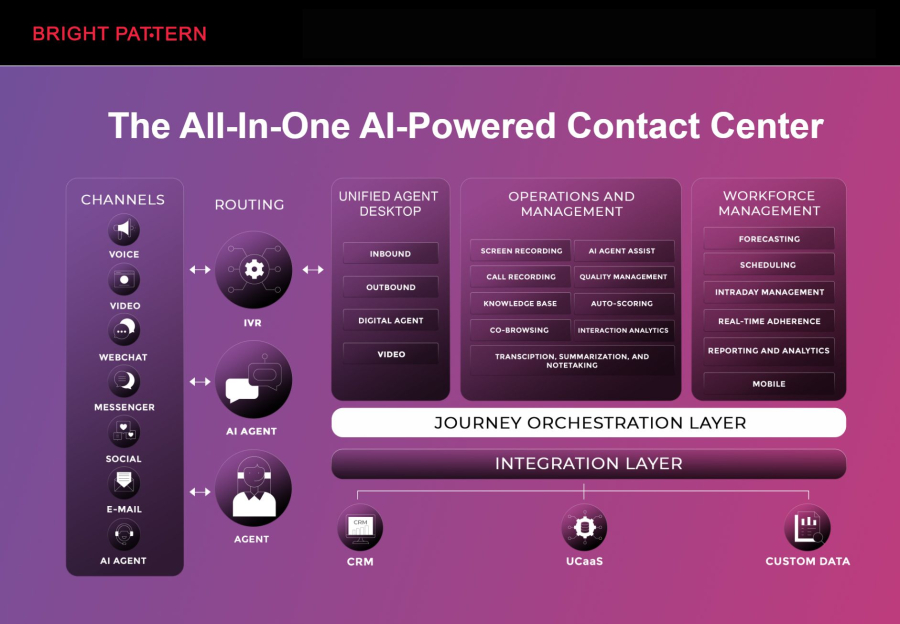
Bright Pattern is a comprehensive AI and call center solution designed to simplify omnichannel customer engagement while enhancing agent performance. By integrating AI tools, predictive analytics, and intelligent automation, Bright Pattern transforms traditional call centers into modern, insight-driven customer experience hubs.
Key Features of Bright Pattern:
- Omnichannel AI routing: Automatically directs customer inquiries to the right agent or AI-powered assistant across voice, chat, email, and social media.
- AI-assisted agent workflows: Reduces manual effort and boosts agent productivity through intelligent suggestions and real-time guidance.
- Advanced analytics and reporting: Provides actionable insights into agent performance, customer behavior, and operational efficiency.
- Seamless ITSM integration: Works with existing service management systems to streamline workflows.
- Scalable cloud-native architecture: Enables organizations to grow without major infrastructure changes.
Bright Pattern not only enhances day-to-day call center operations but also supports future-proofing your call center with AI, ensuring your organization stays ahead in a rapidly evolving customer service landscape.
2. Five9
A cloud-based call center platform with AI-driven predictive dialing and virtual agents.
3. Genesys Cloud CX
Offers AI-powered routing, workforce optimization, and omnichannel engagement capabilities.
4. Talkdesk
Provides intelligent automation, AI-powered analytics, and customizable workflows for modern contact centers.
5. Zendesk Sunshine
Combines AI-driven support automation with a flexible CRM platform for personalized customer service.
6. NICE inContact CXone
A unified AI contact center solution featuring predictive analytics, chatbots, and agent assistance tools.
7. RingCentral Contact Center
Integrates AI-driven insights, workflow automation, and omnichannel communication tools.
8. 8x8 Contact Center
Delivers AI-enhanced call routing, analytics, and virtual assistant capabilities.
9. Amazon Connect
Cloud-based call center service with AI-powered chatbots, voice analytics, and machine learning insights.
10. LivePerson
Focuses on conversational AI to enhance chat, messaging, and voice interactions in customer support.
The Big Wins: Key Benefits of AI in Call Centres
When implemented well, AI delivers value across your call centre ecosystem: customers, agents, leaders and the wider business.
1. Faster, More Convenient Customer Service
Customers expect instant, anytime support. AI helps you meet these expectations without simply adding more headcount.
- 24/7 availabilityvia virtual agents and intelligent IVR, so customers get help even outside business hours.
- Shorter wait timesas AI handles routine queries and routes complex issues to the best suited agent.
- First contact resolutionimprovements, thanks to better knowledge retrieval and guided workflows.
2. Happier, More Effective Agents
AI is a powerful ally for agents on the front line. By removing low-value tasks and providing real-time support, it enables agents to focus on what humans do best: empathy, judgement and relationship building.
- Reduced repetitive workas bots handle password resets, account updates and routine status checks.
- Real-time assistancethat suggests next best actions, compliance prompts and knowledge articles during calls.
- Automatic call notes and summariesthat free agents from time-consuming after-call work.
- Greater job satisfactionas agents deal with more meaningful, complex cases where their expertise shines.
3. Lower Costs With Better Outcomes
AI can significantly improve productivity per agent while maintaining or raising the quality of service.
- Higher self-service containment, reducing the volume of calls needing a human agent.
- Shorter average handle time (AHT)through smarter prompts, automation and instant data retrieval.
- Optimised staffingusing AI-powered forecasting and scheduling to match demand more accurately.
- Less rework and fewer escalations, thanks to better guidance and quality monitoring.
4. Deeper Insight Into Every Conversation
Traditional quality assurance only samples a tiny fraction of calls. AI changes this by analysingeveryinteraction in real time.
- Full-call transcription and analysisfor voice, chat and email interactions.
- Customer sentiment trackingto highlight pain points and moments of delight.
- Trend detectionacross products, policies and processes to inform wider business decisions.
- Agent performance insightsthat enable targeted coaching rather than generic training.
Core AI Use Cases in Modern Call Centres
AI can touch almost every part of a call centre operation. Below are some of the highest-impact use cases with clear, measurable benefits.
1. Intelligent Virtual Agents (IVAs) and Chatbots
IVAs use speech recognition and natural language understanding to hold human-like conversations over the phone or within digital channels. They can:
- Verify identity and authenticate customers.
- Answer frequently asked questions.
- Provide order updates, balances and status information.
- Capture information before handing off to a live agent.
When designed around real customer journeys, IVAs can resolve a significant proportion of contacts end-to-end, while making escalations to live agents smoother and better informed.
2. AI-Powered Routing and Prioritisation
Instead of simple first-in, first-out queues, AI can route each interaction to the agent or team best placed to handle it. This matching can be based on:
- Customer profile and history.
- Topic and complexity of the query.
- Agent skills, experience and performance data.
- Real-time factors such as current load or service level.
The result is higher first contact resolution, fewer transfers and a more efficient use of your specialist skills.
3. Real-Time Agent Assist
Agent assist tools use AI to listen to calls or monitor chat in real time, surfacing what agents need in the moment. Capabilities often include:
- Instant knowledge suggestionsbased on the customer's question.
- Compliance and scripting promptsto ensure mandatory statements are delivered.
- Guided workflowsthat show the next best action, forms and systems to use.
- Upsell and cross-sell suggestionsthat align with the customer's context and eligibility.
This creates a safety net for new agents and accelerates time to competence, while giving experienced agents a boost on complex or unfamiliar topics.
4. Automated Quality Monitoring and Coaching
AI-driven quality monitoring scores 100 percent of calls against your defined criteria and flags those that need attention. You can track:
- Greeting and closing standards.
- Regulatory and compliance wording.
- Empathy and soft skills indicators.
- Silences, overlaps and call control patterns.
Leaders can then use these insights to provide targeted, evidence-based coaching. Over time this leads to more consistent customer experiences and fewer compliance breaches.
5. Workforce Management and Forecasting
Workforce management (WFM) is another area where AI shines. By learning from historic volume, seasonality, marketing activity and external factors, AI systems can:
- Produce more accurate forecasts across channels and queues.
- Recommend optimal staffing plans and shift patterns.
- Simulate 'what if' scenarios, such as new product launches or policy changes.
- Adapt intraday when actual demand diverges from the plan.
This reduces both overstaffing and understaffing, protecting service levels while controlling labour costs.
6. Analytics, Reporting and Root Cause Insight
By converting every call into structured data, AI makes it far easier to understand what is really driving contact volume and customer effort.
- Identify the most common reasons for contact.
- Spot emerging issues before they become complaints.
- Measure sentiment by product, process, channel or region.
- Feed insights back to product, marketing and operations teams.
This turns the call centre into a powerful listening post that guides better decisions across the whole organisation.
At-a-Glance: AI Use Cases and Benefits
| AI use case | Primary benefit | Typical impact area |
| Virtual agents and chatbots | 24/7 self-service and faster resolution | Customer experience, cost to serve |
| AI routing and prioritisation | Better matching of queries to skills | First contact resolution, AHT |
| Real-time agent assist | On-the-job support and guidance | Agent productivity, quality |
| Automated quality monitoring | Consistent, data-driven QA | Compliance, coaching, CSAT |
| Workforce forecasting and scheduling | Better resourcing decisions | Service level, labour cost |
| Conversation analytics | Insight into drivers of contact and sentiment | Continuous improvement, root cause |
How AI Changes the Role of the Call Centre
Introducing AI does more than automate tasks. It changes how the call centre fits within your organisation.
- From reactive to proactive— with early warnings and better forecasting, you can address issues before they trigger a surge in contacts.
- From cost centre to value creator— AI enables revenue-generating conversations, deeper insight and strategic input to product, pricing and policy decisions.
- From scripts to smart guidance— agents are no longer tied to rigid scripts; they are empowered with intelligent prompts that adapt to the customer and context.
- From anecdote to evidence— decisions about process changes, training and technology can be based on complete, data-driven views rather than small samples.
Practical Steps to Introduce AI Into Your Call Centre
You do not need a complete transformation on day one. The most successful AI programmes start focused and build from there.
1. Clarify Your Objectives
Begin with a clear view of what you want AI to achieve. Common objectives include:
- Reducing average handle time or queue times.
- Increasing first contact resolution or self-service containment.
- Improving customer satisfaction (CSAT) or Net Promoter Score (NPS).
- Strengthening compliance and reducing risk.
These goals will guide which use cases to prioritise and how to evaluate success.
2. Map Customer Journeys and Identify Quick Wins
Analyse your existing interactions to find areas where AI can add immediate value. Look for:
- High-volume, low-complexity queries that are ideal for automation.
- Processes with frequent handoffs or repeat contacts.
- Interactions where agents must search across multiple systems.
- Known compliance hotspots or quality issues.
Choose one or two high-impact journeys as pilot candidates. Success here creates momentum and internal support for broader adoption.
3. Engage Agents Early and Often
Agents are the people who will use AI every day, and they often have the best ideas on where it can help most.
- Involve agents in shaping use cases and testing new tools.
- Position AI as a co-pilot that removes friction, not as a replacement.
- Gather feedback continually and adjust workflows accordingly.
When agents feel AI has been builtwiththem, not merely deployedtothem, adoption and impact rise sharply.
4. Start Small, Then Scale
Pilots allow you to test and learn with limited risk. For each pilot:
- Define clear success metrics and a time frame.
- Limit the scope to specific queues, journeys or regions.
- Monitor performance daily in the early stages.
- Capture stories of success to share internally.
Once the pilot proves its value, you can expand to more use cases, channels or markets with greater confidence.
5. Put Data Foundations in Place
AI thrives on high-quality data. To get the best results:
- Ensure call recordings and transcripts are accurate and consistently captured.
- Integrate customer relationship management (CRM) and telephony data where possible.
- Agree data definitions and governance practices across teams.
- Protect customer privacy through appropriate access controls and retention policies.
Strong data practices not only improve AI performance but also build trust with stakeholders and regulators.
Measuring the Impact of AI in Your Call Centre
Robust measurement ensures you can demonstrate value and refine your approach over time. Consider tracking metrics across four dimensions.
1. Customer Experience Metrics
- Customer satisfaction (CSAT) scores for AI-handled and agent-handled contacts.
- Net Promoter Score (NPS) trends.
- Average speed of answer and queue times.
- Customer effort scores or similar measures of ease.
2. Operational Efficiency Metrics
- Average handle time (AHT).
- Call volume handled by self-service versus agents.
- First contact resolution (FCR) rates.
- Transfer and escalation rates.
3. Agent Experience Metrics
- Agent satisfaction or engagement scores.
- Time spent on after-call work.
- Average time to competence for new hires.
- Attrition and absenteeism rates.
4. Compliance and Quality Metrics
- Percentage of interactions monitored automatically.
- Compliance breach rates.
- Quality assurance scores by team and channel.
- Number and severity of complaints.
Addressing Common Concerns Positively
As with any major change, AI in call centres can raise questions. Proactively addressing them helps maintain confidence and momentum.
'Will AI Replace Our Agents?'
In practice, AI is most effective when itaugmentsagents rather than attempting to replace them entirely. It takes on repetitive, rules-based tasks, while humans handle nuanced, emotionally sensitive or complex enquiries.
Many organisations find that AI enables them to:
- Manage growth without continually expanding headcount.
- Redeploy people from low-value work to higher-value, relationship-focused roles.
- Offer more flexible working patterns supported by smart tools.
'Will Our Customers Accept AI?'
Customer acceptance hinges on experience. When AI makes life easier — quick answers, fewer transfers, no waiting on hold — customers tend to embrace it.
- Give customers clear signposting when they are interacting with AI.
- Make it easy to reach a human when needed.
- Continuously refine AI conversations based on real feedback and data.
Done well, AI becomes an invisible helper that simply makes service feel smoother and more responsive.
Future Trends: Where AI and Call Centres Are Heading Next
AI capabilities continue to advance quickly. Several trends are set to further enhance the call centre of the future.
- More natural conversationsas speech recognition and language models become even more accurate and context aware.
- Proactive outreachwhere AI predicts customer needs and offers help before a problem arises.
- Unified customer profilesthat consolidate data across channels, enabling seamless experiences from call to chat to email.
- Richer coaching toolsthat turn every interaction into a learning opportunity, tailored to each agent.
- Deeper integration with back-office processes, so that issues can be resolved end-to-end without manual chasing.
Organisations that invest early in AI-ready processes, data and culture will be best placed to take advantage of these innovations as they mature.
Conclusion: Turning Your Call Centre Into a Strategic Advantage With AI
AI offers call centres a compelling opportunity: faster service, happier customers, more empowered agents and lower operating costs, all at the same time. By starting with clear objectives, focusing on high-impact journeys and involving your agents throughout, you can introduce AI in a way that feels natural, supportive and effective.
Rather than viewing AI as a distant, disruptive technology, see it as a practical toolkit to enhance what your call centre already does well. Step by step, you can transform your operation into a high-performance, insight-rich customer experience hub that stands out in your market.
The organisations that act now will not just keep pace with changing expectations — they will set the standard for what great service looks like in an AI-enabled world.
